

University of Guam Press | Is That An Aga?
UOG Press
University of Guam Press | Is That An Aga?
About the Birds and Island in Is That an Åga?
The University of Guam Press published the beautiful board book, Is That an Åga by Emily Louina Cook and illustrated by Joanne F. Almajose. The book helps readers learn how to spot this special bird, and also introduces them to other birds in the island of Luta (Rota) in the Mariana Islands. This page is dedicated to sharing more information about the Åga and other birds from the book.
Åga

Once, there were over 1,000 Åga in Luta. In 2015, there were only 130 Åga in Luta.
The number of Åga in Luta today has increased to an estimated 300 birds. With care
from people, the Åga is being saved from extinction.
The first step to protecting the Åga is recognizing it. The Åga is distinguishable
from other dark birds by its large bill, fan-shaped tail, and distinctive caw-like
sound. Lighting can make other birds seem like the Åga, and the Åga also spends time
on the ground like the Månnok, or Chicken. So, look closely to be sure you spotted
an Åga!
More about the Marianas birds featured in Is That an Åga?
Månnok

Wild ancestors of Chickens, called Jungle Fowl (Gallus gallus), and domestic Chickens are common in Luta, and are capable of short flights. Gallus gallus are found in parts of southern Asia and other islands, with a declining population. Both can have dark coloration, including black feathers. Sometimes, lighting and surroundings make the Månnok (and other birds) seem darker than they are. Like the Åga, the Månnok can be found on the ground or perched in trees.
Såli

The Såli is found in other Micronesian islands besides Luta. There is not enough data to know the bird’s population status, so they are not considered endangered. Såli are distinguishable from Åga due to their yellow eyes and smaller size. Young Såli have black and white stripes on their breast.
Salin Taiwan

There are multiple Drongo species around the world. The Salin Taiwan is found in many parts of Asia, and their population is considered stable. They were introduced to Luta to control pest insects. The Salin Taiwan is distinguishable from the Åga due to their long, forked tail, smaller size, and tendency to perch on power lines.
Fåhang Dånkolo

The Fåhang Dånkolo has a distribution over most of the tropical and subtropical world, and their population is considered stable. They often appear darker than they are due to lighting conditions. Most people see the Fåhang Dånkolo in Luta high in the sky, near nests on cliffs, or looking for food over the ocean. In addition to a lighter coloration, the Fåhang Dånkolo is distinguishable from the Åga by their body shape, webbed feet, and oceanic foraging habits.
Luta, Guåhan, and the Mariana Islands
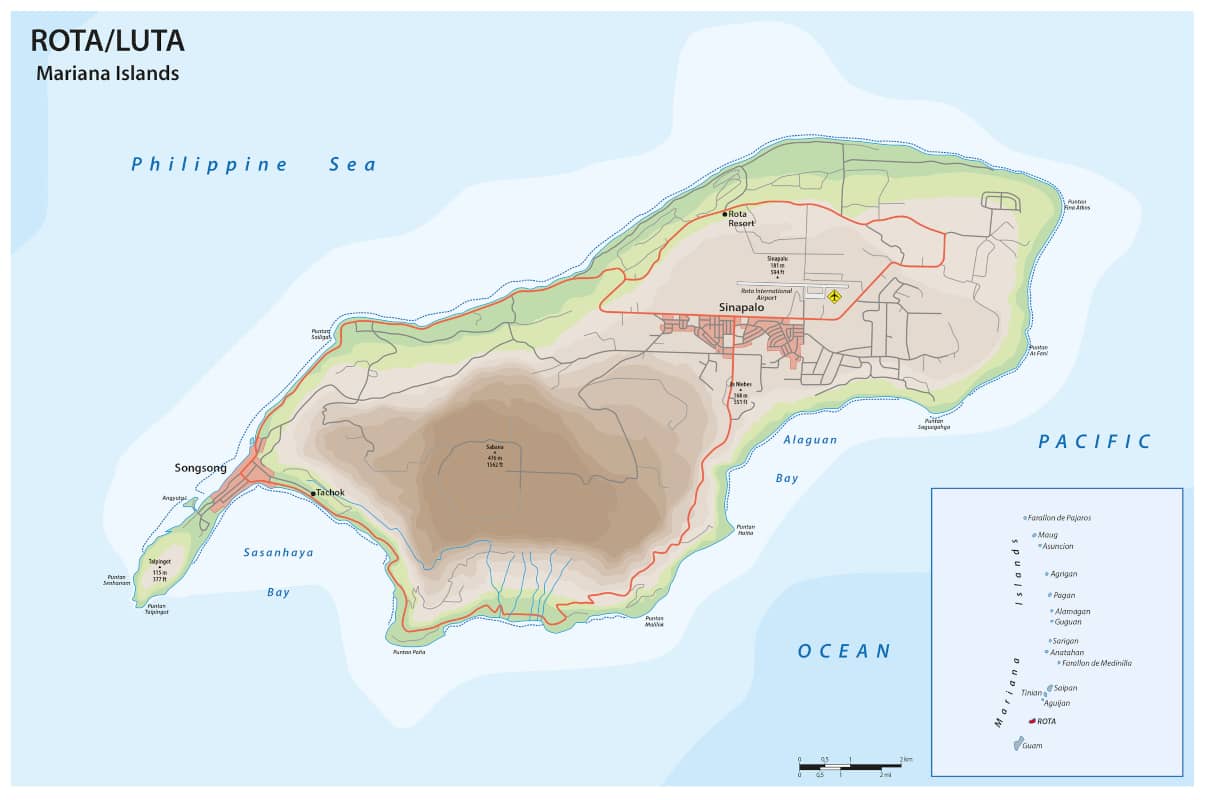
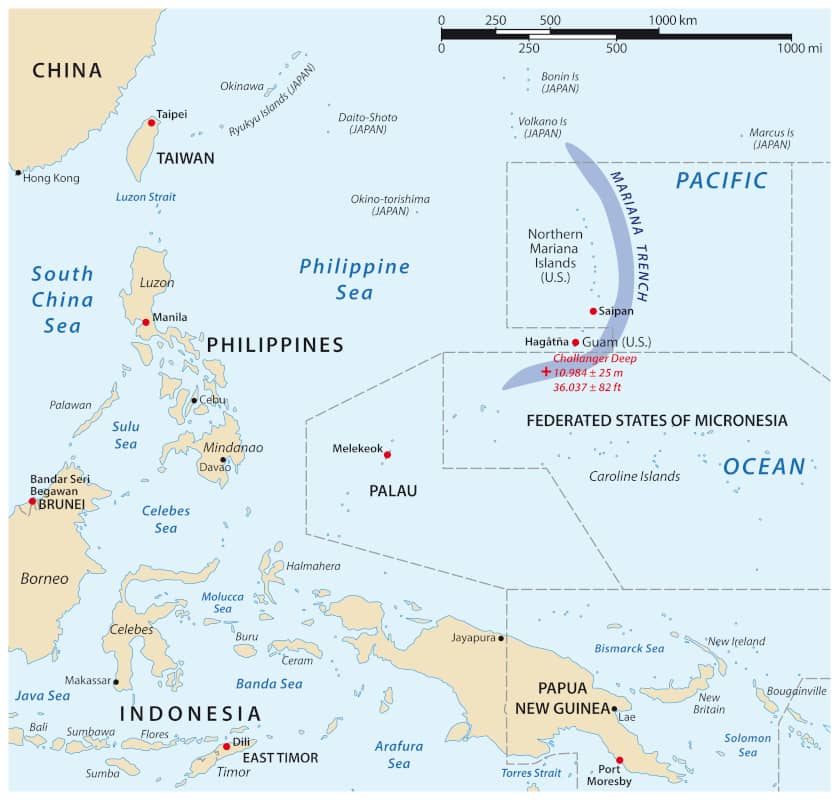
Luta is also known as Rota, and is part of the Mariana Islands. Luta has about 10 forest bird species. Just over 100 bird species, including oceanic birds, have been seen in Luta.
Guåhan is also known as Guam, and is the largest islands in the Mariana Islands. Guåhan once had about 12 forest bird species. The invasive, introduced brown tree snake caused the extinction and/or extirpation of most of them. About 150 bird species, including oceanic birds, have been seen in Guåhan.
There are 13 other main islands in the Mariana Islands. It is one of the most isolated island chains in the world. Over 200 bird species have been recorded here. The ocean surrounding the islands contains the Mariana Trench, the deepest trench in the world. The islands north of Guåhan are known as the Northern Mariana Islands. The Northern Mariana Islands are currently classified as a United States Commonwealth, while Guåhan is classified as a United States Territory.
The Indigenous or first people of the Marianas are the CHamoru, or Chamorro, which is also the name of their language. These islands have been their home for nearly 4,000 years! The islands have a 500-year history of colonization. They share diverse influences from Spain, Japan, Germany, the Philippines, other Pacific Islands, and more.
The Åga…
- Does not fly to other islands
- Cannot mate with other crow species
- Makes many different vocal sounds
- Is known to play
- Takes over 70 days to nest
And You…
- Can be a scientist by submitting your bird observations to ebird.org
- Are an important part of conservation just by reading this story to others
- Can help birds by protecting native plants and habitats
Frequently Asked Questions
- Are the Åga like other Crows?
Yes and no. There are many Crow species in the world. Crow species are part of the corvidae family, commonly known as corvids. Corvids include Crows, Ravens, Rooks, Jays, and more. There are over 100 different corvids in the world. Åga are smaller than the American Crow (Corvus brachyrhynchos), have slightly different vocalizations, and are more reclusive. - What’s the difference between “in Luta” versus “on Luta”?
While both phrases are acceptable, “on” is sometimes considered to have colonialistic connotations. “In” was used in the body of this story for consistency with the original CHamoru island names. - Are the Mariana Islands an island chain or archipelago?
They are both. An archipelago is an area of water containing a scattering of islands. A chain tends to refer only to the land mass of islands, which are in an approximate line. - What’s the difference between an extirpated and extinct bird?
An extirpated species is no longer found in a location but still exists in the world. Sometimes they exist elsewhere in the wild, and sometimes only in captivity. An extinct species is gone from Earth forever. Åga are extirpated from Guåhan but still exist in Luta. - What’s the little circle over the letter “A” in Åga?
This is an accent, also known as a diacritic, that helps people know how to pronounce a letter. This one is called an overring and is used in multiple languages. In this instance, Åga is pronounced: Ah-gah. - Do I need binoculars to watch birds?
No! Binoculars are helpful tools to see birds far away and not disturb them, but you can observe birds without them. To have the best view, be quiet and move slowly.