

UOG Land Grant | Pomology & Plant Physiology Research Lab
UOG Land Grant | Pomology & Plant Physiology Research Lab
UOG Land Grant | Pomology & Plant Physiology Research Lab
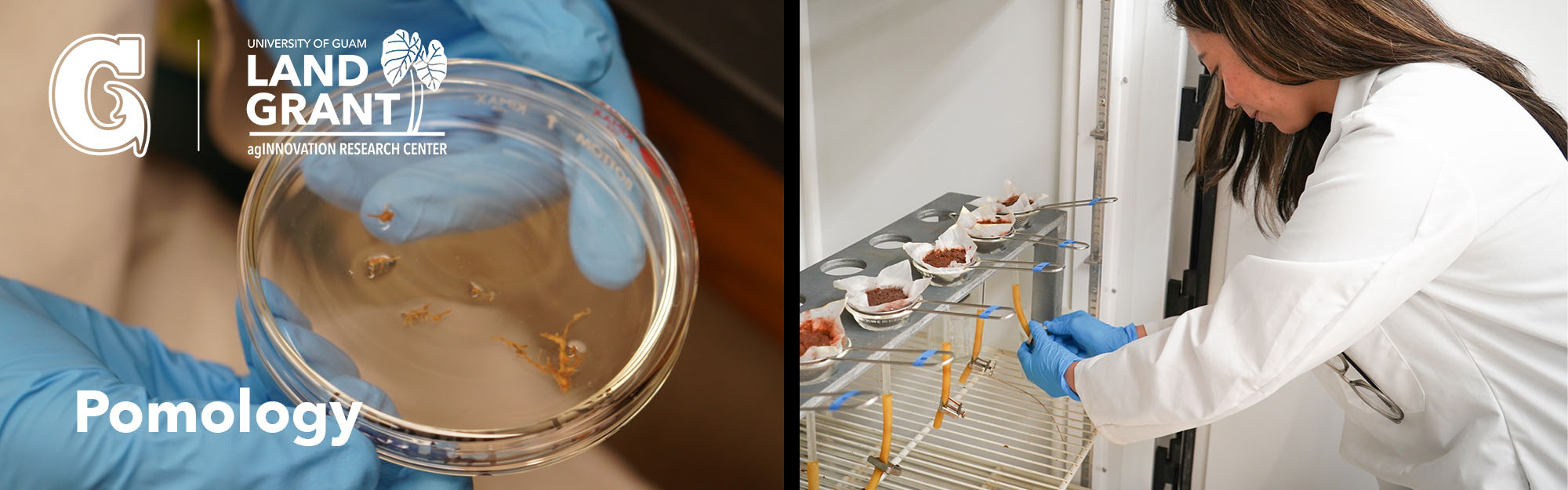
Tropical fruit crop research at the University of Guam
The goal of our research in the UOG Land Grant agInnovation Research Center Pomology & Plant Physiology Laboratory is to improve the productivity, health, resilience, and sustainability of tropical fruit crops and other economically important crops in Guam and the wider Western Pacific.
Our laboratory focuses on generating locally validated, science-based information that can support fruit tree establishment and rehabilitation, cultivar evaluation, propagation, flowering and fruit development, plant growth and physiology, fruit quality, sustainable soil amendments, plant–nematode interactions, beneficial and plant-parasitic nematodes, and responses to biotic and abiotic stresses.
Overall, our basic and applied research covers:
- sustainable plant production
- pomology
- plant physiology
- biochemistry
- molecular plant biology
- nematology
- plant health
- soil and root health
- molecular diagnostics.
Addressing challenges of tropical fruit farmers in Guam and the Western Pacific
Farmers and growers in Guam and the wider Western Pacific operate under conditions that are not always adequately represented by recommendations developed in continental or temperate production systems. Important challenges include typhoons and other extreme weather events, contrasting limestone and volcanic soils, introduced pests and diseases, plant-parasitic nematodes, limited information on cultivar performance under island conditions, and the rehabilitation of aging or storm-damaged orchards.
In addition, baseline information on the diversity, distribution, abundance, host associations, and economic importance of several crop pests, particularly plant-parasitic nematodes, remains limited in the region.
Our research faculty work closely with the UOG Land Grant Extension Service so that challenges identified by farmers, growers, extension personnel, and community partners can be translated into research questions. These questions may be investigated through field surveys, surveillance, observations, diagnostic work, controlled experiments, and laboratory analysis. Findings are then documented and validated so that useful results can be translated through UOG Extension into demonstrations, workshops, educational materials, publications and practical recommendations for growers and communities.
Latest research in tropical fruit production for Guam and Micronesia
Our research activities connect community needs, field research, fundamental plant science, education, and extension. Through this integrated approach, the Pomology & Plant Physiology Laboratory contributes to UOG's research, education, and extension missions while strengthening local and regional capacity in tropical pomology, plant physiology, plant health, nematology, sustainable crop production, and agricultural diagnostics.
Recent accomplishments
- Expansion and rehabilitation of UOG fruit research orchards, resulting in approximately 20 new fruit trees for long-term evaluation
- Integration of new field sampling procedures for the region to improve diagnostic capacity and documentation, including nematode extraction, morphological and morphometric identification, and DNA extraction
- Documentation of beneficial nematodes in Guam’s agricultural soils that may contribute to natural suppression of damaging nematode populations
- Mango research examining flowering, fruit set, oxidative signaling, and ascorbate-related physiological responses under tropical post-typhoon conditions
- Evaluation of sustainable soil amendments, such as biochar and compost
Ongoing research
Survey and establishment of diagnostic methods for plant-parasitic nematodes of priority crops in Guam, NMI, and FSM
This regional project surveys plant-parasitic nematodes associated with priority crops in Guam, the Northern Mariana Islands, and the Federated States of Micronesia. The project addresses limited baseline information on the abundance, distribution, diversity, and host associations of plant-parasitic nematodes in the region. Field surveys are combined with nematode extraction, microscopy, morphological and morphometric identification, and molecular diagnostic approaches. The project also supports the development and standardization of regional sampling and diagnostic procedures while strengthening local capacity for morphological and molecular identification of agriculturally important nematodes.
Funding Source: Animal & Plant Health Inspection Service - Plant Protection & Quarantine, U.S. Department of AgricultureTropical fruit orchard rehabilitation, replanting, and cultivar evaluation
This research evaluates tropical fruit trees and cultivars across three UOG research locations representing different environmental and soil conditions in Guam. Historical orchard records and current field surveys are being used to assess tree survival, cultivar retention, plant health, orchard condition, and areas requiring rehabilitation or re-establishment. The program is actively introducing and evaluating additional fruit tree species and cultivars to replenish existing orchards and increase the diversity of material available for research. Approximately 20 new fruit trees have been established at the Yigo research site as part of the ongoing orchard rehabilitation effort. New plantings include:
- mango
- avocado
- atis
- dragon fruit
- coffee
- fig
- other tropical fruit and perennial species as suitable planting material becomes available.
Because perennial fruit trees may require several years before reliable flowering, fruiting, and yield data can be collected, evaluations begin immediately after establishment. Measurements include survivability, plant height, stem growth, canopy development, general plant vigor, phenology, and visible responses to pests, diseases, and environmental stresses. As the trees mature, flowering, fruit set, yield, and fruit-quality characteristics will be incorporated into the long-term assessments.
The objective is to identify fruit species and cultivars that establish successfully, remain healthy, and perform reliably under different Guam environments and to develop locally relevant information for orchard establishment, rehabilitation, cultivar selection, and resilient tropical fruit production.
Funding Source: Hatch Act Capacity Grant, U.S. Department of AgricultureFruit tree nursery establishment and early seedling evaluation
Two fruit tree nursery platforms have been established, one at the UOG Land Grant experiment station in Yigo and one on the UOG campus, to support propagation and early-stage evaluation of fruit trees before field establishment. The nurseries provide an opportunity to monitor germination or propagation success, seedling establishment, growth rate, plant vigor, root and shoot development, and early responses to pests, diseases, and environmental conditions under more manageable conditions. Healthy and well-established planting material can subsequently be transplanted to field research sites for continued long-term evaluation.
This nursery-to-field approach allows the program to document plant performance from the early propagation stage through establishment, maturity, flowering, and eventual fruit production. The nurseries also provide plant material for research, student training, propagation studies, and future orchard rehabilitation activities.
Funding source: Hatch Act Capacity Grant, U.S. Department of Agriculture
Sustainable soil amendments for crop growth, productivity, and soil health
This research evaluates sustainable soil amendments and growing substrates that may improve plant establishment, growth, productivity, and soil and root health under tropical production conditions. Particular emphasis is being placed on locally relevant or sustainable materials, such as biochar and compost. Experiments are being conducted with fruit crops and shorter duration vegetable crops to determine how different amendment rates and combinations influence plant performance. Papaya serves as an important perennial fruit-crop model, while crops such as French bean provide a shorter experimental cycle in which growth, biomass, flowering, pod production, and yield responses can be evaluated more rapidly.
Measurements may include germination and establishment, plant height, stem diameter, leaf and canopy development, chlorophyll status, root growth, biomass, flowering, yield, soil and root health, and pest or nematode responses.
Comparisons between amended and non-amended soils are intended to determine whether sustainable substrates including sap tube substrate can improve crop performance and help develop practical soil-management options for Guam growers.
Funding source: Hatch Act Capacity Grant, U.S. Department of Agriculture
Papaya biochar, plant health, nematode interaction, and fruit physiology research
Papaya is being used as a model tropical fruit crop to investigate interactions among sustainable soil amendments, plant growth, root health, plant physiology, nematode infection, yield, and fruit quality. Field and controlled studies evaluate different biochar treatments and their effects on plant establishment, height, canopy development, flowering, fruit production, root development, and plant health. Complementary experiments examine responses under root-knot nematode pressure using inoculated and non-inoculated treatments. Measurements include plant growth, chlorophyll, biomass, root architecture, root galling, egg masses, nematode populations, and physiological or biochemical indicators associated with plant stress and defense.
Related research investigates whether preharvest soil-amendment treatments influence fruit development and postharvest quality. Fruit characteristics evaluated include size, weight, firmness, peel color, soluble solids, acidity, vitamin C, and ripening behavior. Together, these studies seek to determine whether sustainable soil amendments can improve papaya production while also providing a better understanding of the physiological mechanisms underlying plant responses to soil conditions and biological stress.
Funding source: Hatch Act Capacity Grant, U.S. Department of Agriculture
Plant physiology and biochemical mechanisms of growth and stress response
In addition to field-based production research, the program conducts fundamental laboratory studies to better understand the physiological and biochemical mechanisms underlying differences in plant growth, productivity, and stress tolerance. Research examines changes in compounds and pathways associated with plant growth and defense, including plant growth regulators, ascorbic acid metabolism, antioxidant responses, and selected primary and secondary metabolites. These measurements can be linked with observations of plant growth, flowering, fruit development, soil amendments, pest or nematode pressure, and environmental stress.
The purpose of this work is to move beyond simply documenting whether a treatment improves plant performance and to investigate why the response occurs. Integrating physiological and biochemical measurements with field and greenhouse experiments can help identify mechanisms associated with improved growth, stress tolerance, plant defense, and fruit development under tropical island conditions.
Funding source: Hatch Act Capacity Grant, U.S. Department of Agriculture
Papaya seed source, germination, and sex determination
This project investigates whether the maternal fruit from which papaya seed is collected influences seed characteristics, germination, early seedling development, and the sex composition of the resulting generation. Seeds originating from female and hermaphrodite fruits are compared for germination and seedling performance, while molecular markers are used to identify sex-associated genotypes prior to flowering. The research is intended to determine whether seed source and fruit type provide useful information for papaya propagation and seed selection and, ultimately, whether locally generated seed-production information can help growers establish more predictable papaya populations.
Funding source: Hatch Act Capacity Grant, U.S. Department of Agriculture
Crop–nematode interaction and diagnostic research
This project involves focused studies of plant-parasitic nematodes associated with fruit crops and other economically important crops in Guam. These studies complement the broader USDA APHIS regional survey by allowing specific crop–nematode relationships to be examined in greater detail. Current work includes crop-specific investigations involving calamansi, papaya, tomato, banana, and other locally important crops. Research combines field sampling, soil and root nematode extraction, population assessment, microscopy, morphological and morphometric characterization, molecular diagnostic methods, and measurements of plant growth and root health. Controlled experiments are also used where appropriate to determine how nematode infection influences plant establishment, root development, growth, and productivity and to evaluate potential sustainable management approaches. This work contributes to the development of baseline information, improved diagnostic capability, and future integrated pest-management recommendations for Guam and the wider Western Pacific.
Funding source: Hatch Act Capacity Grant, U.S. Department of Agriculture
Publications
The following journal articles, research summaries, and technical reports are products associated with the current UOG Pomology & Plant Physiology Laboratory.
| Publication | Publisher | Publication Type | Date |
|---|---|---|---|
| Redox regulation is associated with potassium nitrate-induced flowering and fruit set in mango cultivars under post-typhoon tropical conditions | Scientia Horticulturae | Peer-reviewed journal article | September 2026 |
| Buidling orchard resilience in Guam: Lessons learned from abiotic stress | UOG Land Grant agInnovation Research Center | Research summary | June 2026 |
| Enhancing ecosystem health: Nematode presence in UOG's mango orchards | UOG Land Grant agInnovation Research Center | Research summary | June 2026 |
| Comparative stress assessment of mango cultivars at Ija Research & Education Center, Guam | UOG Land Grant agInnovation Research Center | Technical report | December 2025 |
| The role of predatory nematodes in managing plant-parasitic nematodes | Frontiers in Plant Science | Peer-reviewed journal article | December 2025 |
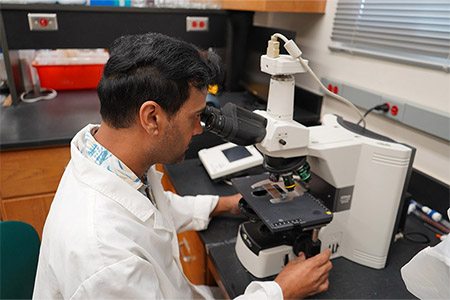
A new UOG agInnovation Research Center study explores how good nematodes can help control harmful ones.
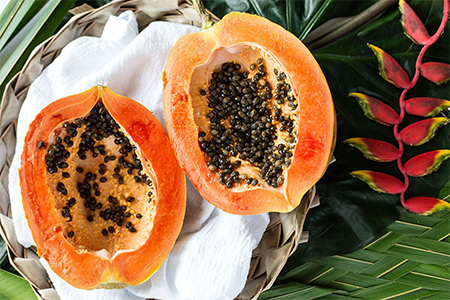
Guam's tropical climate and abundant sunshine make it home to a variety of colorful, flavorful fruits.
Last Updated: October 2026
 The work of UOG Land Grant is supported by the U.S. Department of Agriculture’s National
Institute of Food & Agriculture and the government of Guam. USDA and UOG are equal-opportunity
providers.
RESEARCHER:
Richard R. Singh, Ph.D.
ALS Bldg., Room 319
Phone: (671) 735-2130
Email: singhr@triton.uog.edu