
Tåotao Tritons | Katherine Perez and Cultivating Change in Guam’s Agricultural Scene
Tåotao Tritons | Katherine Perez and Cultivating Change in Guam’s Agricultural Scene
Tåotao Tritons | Katherine Perez and Cultivating Change in Guam’s Agricultural Scene
5/8/2026
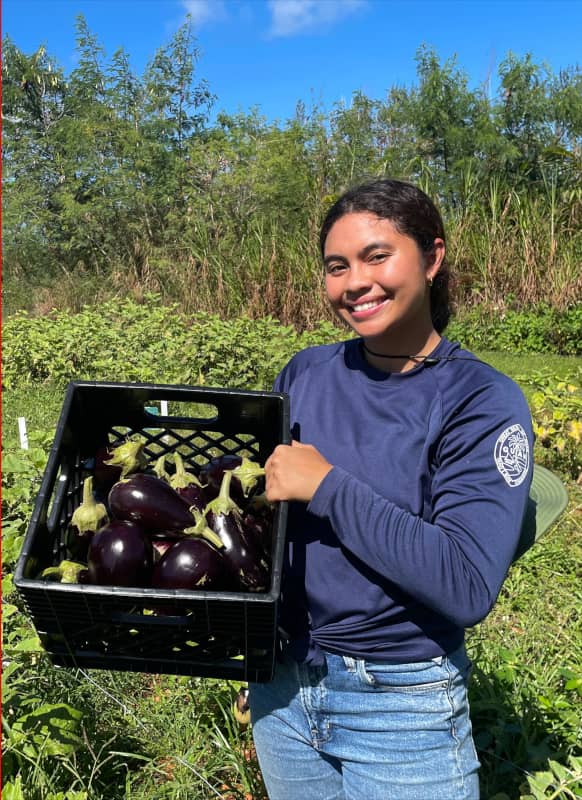

When it comes to putting in the time and work for her future career, Katherine Perez doesn’t mind getting her hands dirty—both literally and figuratively. The 2024 University of Guam alumna and current graduate student in the Master of Science in Sustainable Agriculture, Food, and Natural Resources (SAFNR) program is part of a new generation that is redefining what it means to work in the field of agriculture.
Taking on a New Path
Perez began her undergraduate years as a biology major who was considering a profession in marine conservation, but the COVID-19 pandemic altered her plans. That same semester, she was taking AL-101: Introduction to Agriculture and found that she really enjoyed the course. When lockdowns forced classes to migrate online, it gave Perez the space and time to reflect on her academic trajectory.
“I was yearning to go back to doing the lab for AL-101 because we had set up a whole field, from irrigation to seed preparation. I was really yearning for that hands-on work,” Perez says.
She began planting more on her own at home and even started an Instagram account to document her progress. It also became a way for her to reconnect with family traditions.
“As a kid growing up, we used to go to our ranch every week and bond as a family. When I was living at my grandparents’ house, one of their hobbies was gardening, and even my great-great grandfather raised hundreds of cattle, so all that’s embedded in my family,” Perez explains.
Agriculture had always been a part of Perez’s story even if it hadn’t been her focus, but once students were able to safely return to in-person classes at UOG, Perez decided it was time to make a change. She switched her major to Agriculture while keeping a minor in Biology.

Building Knowledge and Skills
Committed to her new field of study, Perez immersed herself in a range of experiences at UOG. She spent a year and a half working in the soil lab of the Western Pacific Tropical Research Center, now known as the agInnovation Research Center, where she assisted in soil research, sampling, and analysis. A six-month internship at the Fadian Hatchery had her caring for and harvesting shrimp. At one point, she was picked up to do extension work that involved collecting data from local farmers.
A few of Perez’s experiences were unplanned, but no less impactful to her growing knowledge base and skillset. A seemingly straightforward beekeeping workshop is the prime example that comes to Perez’s mind.
“I thought it was just a typical workshop where you learn a little about beekeeping, but they handed us the bee kit supplies and said, ‘When you’re done building it, we’ll give you the bees and help you with monthly workshops for a year, but after that you’re on your own,’” she recalls with a laugh. “It was a total accident, but yeah, it just stuck.”
Perez is now the Secretary of the Guam Beekeepers Association and continues to tend to her hives.

Expanding the Experience
Perez’s willingness to expand her agricultural experience is clear in her life outside of UOG.
In addition to beekeeping, she also raises chickens and quails for their eggs. Eventually, she would like to use her internship experience to give shrimp production a try, though her current venture is in livestock and learning how to properly care for cows under the guidance of her partner, Pedro Blas.
In terms of plant farming, Perez grows herbs like mint and basil; a variety of local crops, including suni (taro), sigidiyas (wing beans), and kalamasa (pumpkin); and newer crops like roselle, a type of hibiscus that can be made into teas, jams, and other goods. Her rotation of harvests has enabled Perez to open her small business, Tånom Mo'na Farm, and sell her products.
“In agriculture, you have so many outlets to try different passion projects,” Perez says.

Points of Impact
The physical labor of farming is just one part of Perez’s work within the discipline. She aims to create as much meaning and impact as possible through her endeavors.
For the SAFNR program, Perez is preparing to defend her graduate thesis, which is a cost-production analysis of hot pepper and eggplant crops on Guam. The resulting data will help local farmers make informed decisions about their production practices through potential financial risks and gains, which is crucial since the last time a similar analysis was done was over 20 years ago.
“It’s about helping farmers understand their operations. They have so much love for what they do, their livelihood, but they need to make all kinds of decisions to stay afloat,” Perez says.
Another goal of Perez’s is to shift the mindset of those who believe Agriculture is just “putting things into the ground.” She points out its connections with other fields, from business and economics to history and cultural studies, hoping to encourage others to be open to the possibilities of the discipline, whether as a career choice or even just as a hobby.
With the ultimate goal to enhance food security on the island, Perez understands the importance of sharing the agricultural knowledge she has gained throughout the years. As such, it finds its way into Perez’s research, into her small business, and in the everyday conversations she has with people who are curious about the subject.
“I want to make sure that the knowledge that I’ve learned is embedded in every part of my work because it’s not mine to keep,” Perez affirms. It is this mentality that makes Agriculture more than something Perez simply studies; it is a way of life she actively embodies and advocates.