Tåotao Tritons | Keep the Words Flowing: Siñot Cody Lizama and Nurturing the CHamoru Language
Tåotao Tritons | Keep the Words Flowing: Siñot Cody Lizama and Nurturing the CHamoru Language
Tåotao Tritons | Keep the Words Flowing: Siñot Cody Lizama and Nurturing the CHamoru Language
3/20/2026
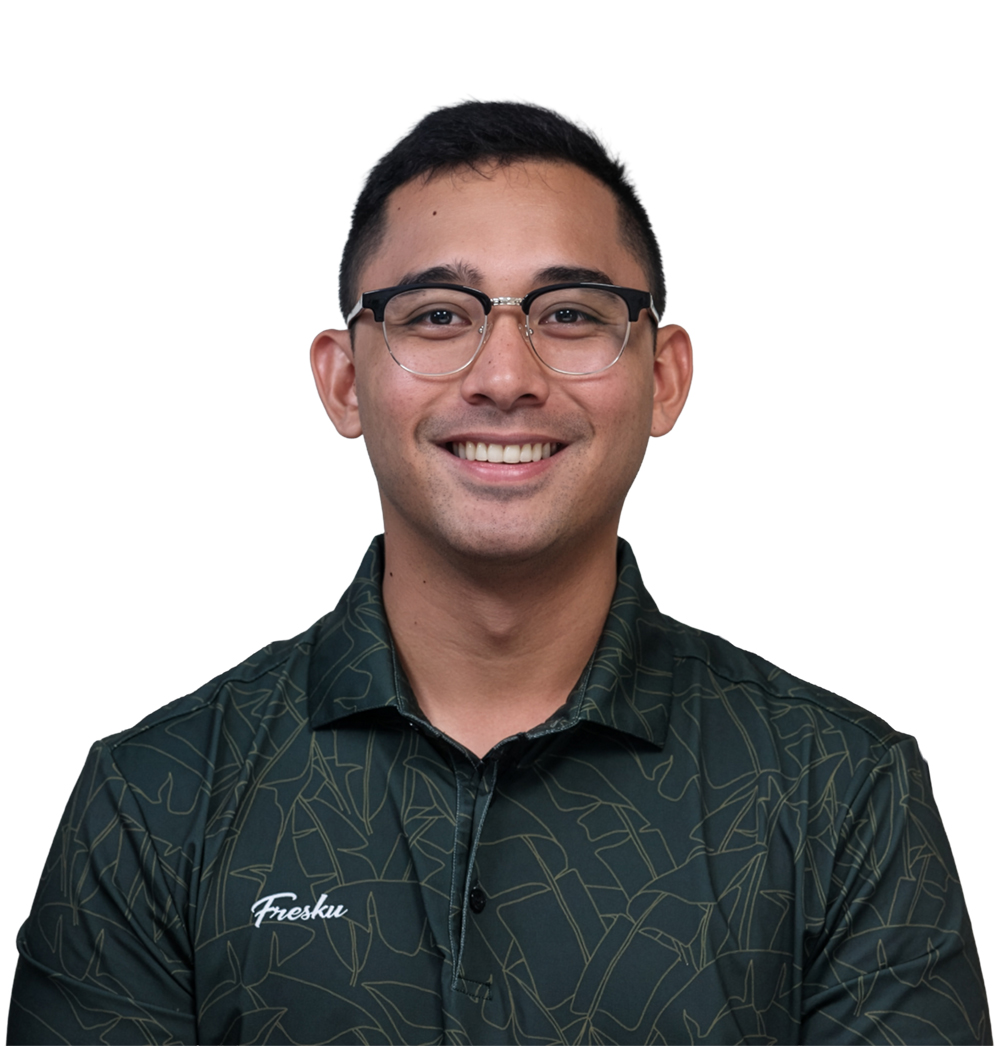
Anyone looking for Siñot Cody Lizama at his family gatherings is sure to find him sitting with the manåmko', or elders, as they share stories and exchange gossip in CHamoru. While he is often the youngest person in those circles, Lizama isn’t a passive observer; he is an active participant who is able to engage confidently in the conversation. As a student, educator, and advocate of CHamoru, Lizama’s journey in learning and speaking the language is a lifelong one that has been challenging but also extremely rewarding.
Homegrown Beginnings
Growing up, Lizama was surrounded by the sound and rhythm of CHamoru spoken fluently by family members. Despite the early exposure, Lizama, who is currently a UOG Instructor of CHamoru Studies[VZ1] , is quick to make the surprising admission that he himself is not a native speaker. The fact is important for him to share because the number of native speakers of CHamoru is dwindling, considering most of them are aging manåmko'.
“They are still around, and there are a good number too,” Lizama clarifies, “but it's important to note because me, at my level that I'm able to speak the language, I want to use it as proof for everybody that, ‘hey, this is still very much doable.’”
His deeper connection to CHamoru began in high school when his nånan biha, or grandmother,
moved in with the family. The time Lizama spent with her, listening to her sing songs
and reminisce about her life, sparked in him a stronger interest to learn to speak
the language that would extend beyond his family.
Lessons from the Classroom
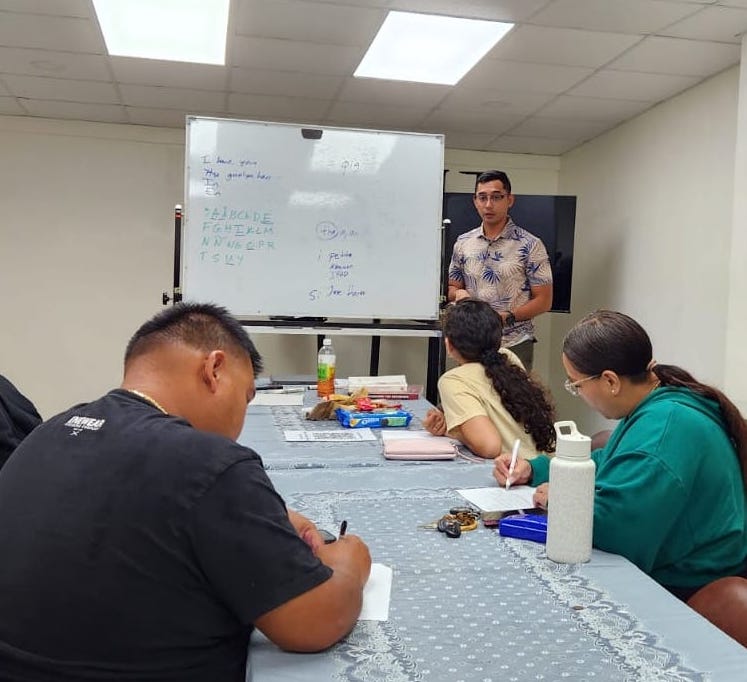
At UOG, Lizama double majored in Social Work and CHamoru Studies. The classes offered him the opportunity to study the formal aspects of the language, from grammar rules to sentence structure. He was then able to take that classroom knowledge and apply it at home. The result was nothing short of amazing.
“When I was actually able to put words together to make a coherent sentence that my grandma could understand, it was the greatest feeling in the world,” Lizama shares.
In addition to expanding the way Lizama communicated with a loved one, developing
his language skills cultivated an even more meaningful relationship to his cultural
heritage and identity. “In many ways, it is like speaking to your ancestor.”
Learning Through Practice—and Mistakes
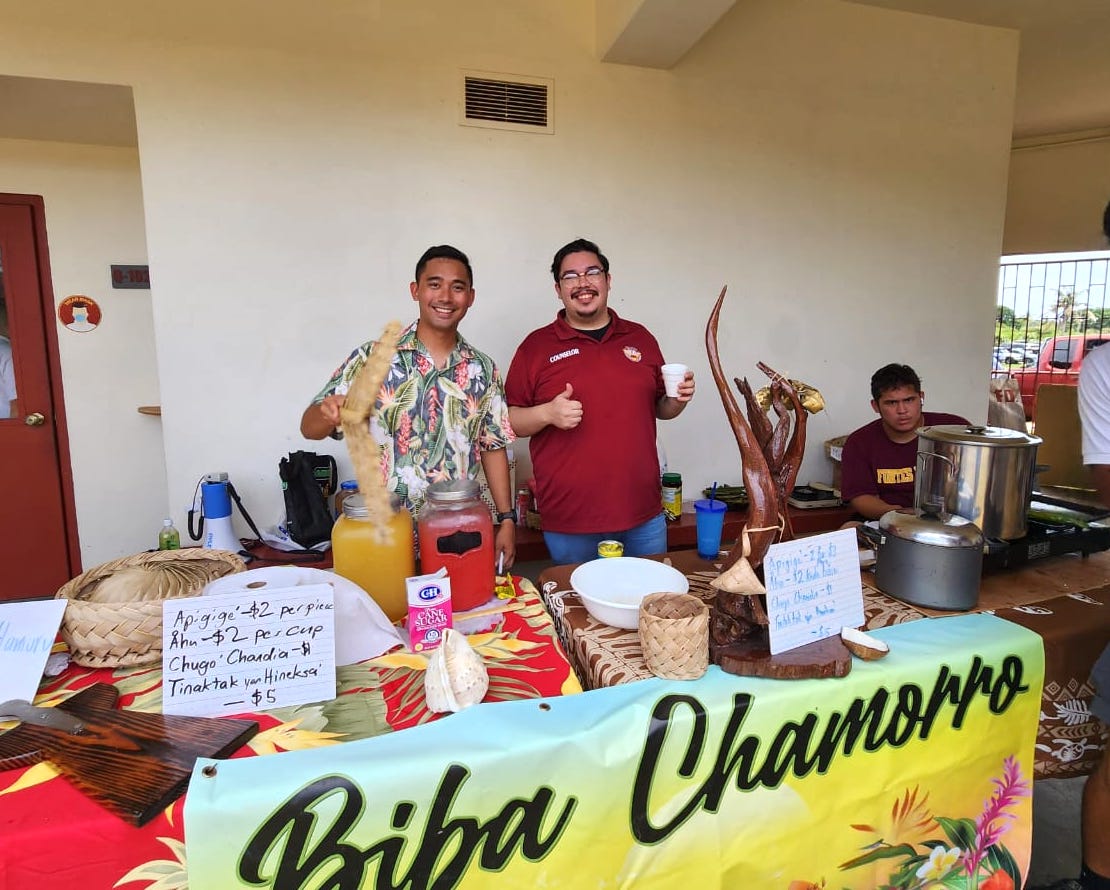
As his speaking abilities improved, Lizama was able to practice even more, especially during the several years he spent as a friar. Priests like Påle' Eric Forbes and the late Påle' Jose Villagomez urged him to build on the academic knowledge he gained at UOG.
“Every time I had a class at UOG, I'd return home to the friary, and I would talk to them and share what I learned. They would say, ‘Oh yeah, that's good. Now use it like this,” he says.
Lizama’s interactions didn’t always go smoothly though. Sometimes he would use words incorrectly or string together his sentences in a clumsy way, earning him outright laughter or even worse, awkward silence.
These experiences—both the encouraging and embarrassing ones—strengthened Lizama’s language skills and helped him realize how overcoming the fear of making mistakes is crucial in learning CHamoru. Although it was never a major issue for him, Lizama understands that mamåhlao, or shame, can be an obstacle for some learners, particularly when there is the possibility of getting kasse-d, or teased, for making errors.
“So many times I said something wrong, and I just had to carry it with me. That's
part of growing. You just have to get past the shame and keeping moving forward,”
Lizama says.
Walking the Walk and Talking the Talk
After leaving the friary, Lizama became a religion teacher at Father Dueñas Memorial School, where it wasn’t long before students started asking him to teach them CHamoru. An after-school program eventually became an official class offering, and in the six years Lizama was at FD, it revealed a powerful truth: “There's no shortage of desire amongst CHamorus to know their own language and culture.”
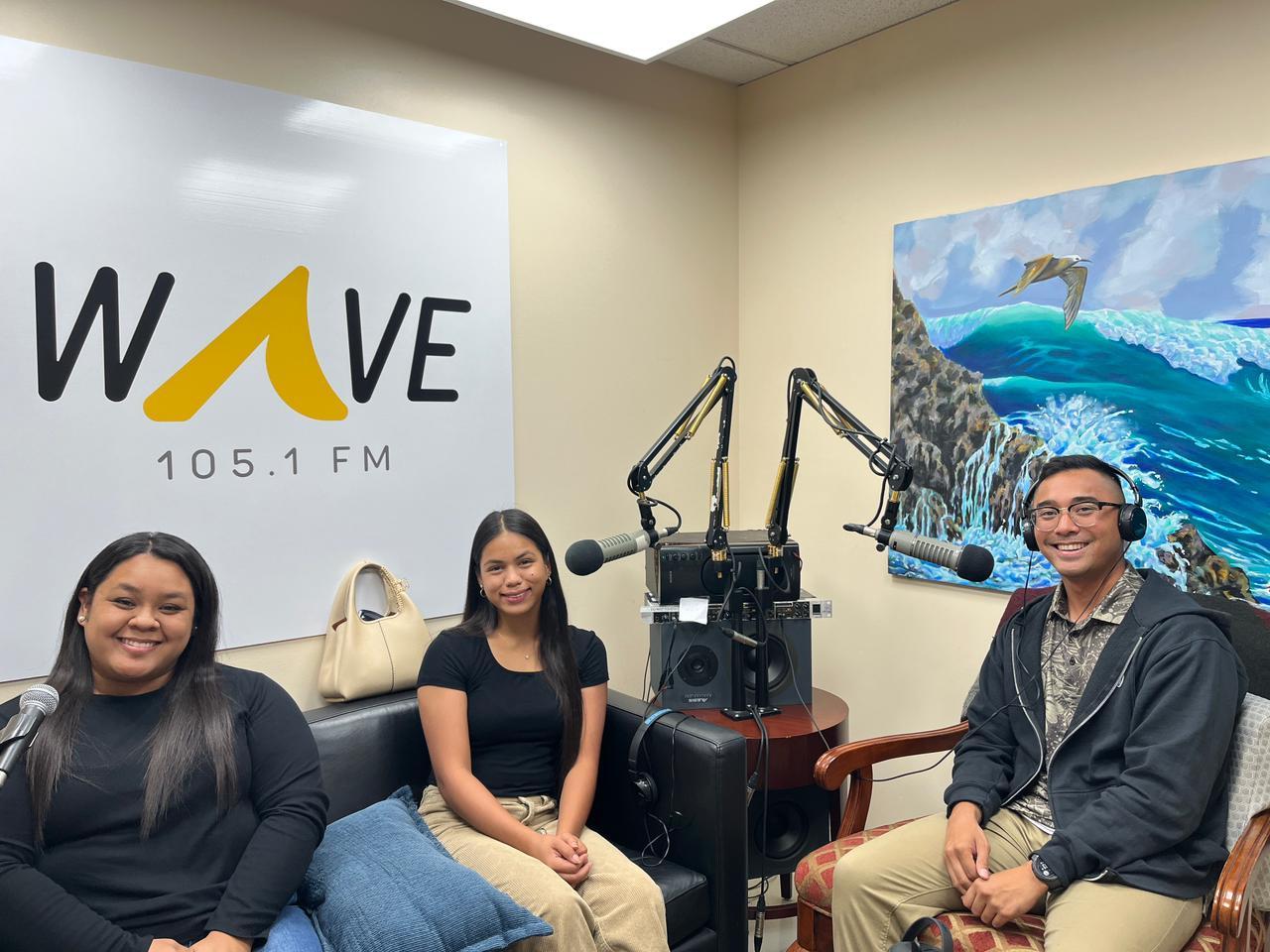
This realization held true with older students as Lizama took on an adjunct position at UOG and later, his current full-time role with the CHamoru Studies program. In this role, Lizama engaged an even wider audience with discussions on the language through Oran Fino' CHamoru, a radio show produced in partnership with WAVE 105 and funded by a Mellon Foundation grant [VZ2] secured by the CHamoru Studies program. Lizama was the show’s host.
Today, along with his continued teaching, Lizama immerses himself in CHamoru in various
settings. He attends the CHamoru-language Mass at Santa Rita church, often helping
with novenas and rosaries. Through his membership in the Young Men’s League of Guam,
he has made village visits to talk about the need to revitalize and perpetuate the
language. And of course, Lizama still hangs out and chats with manåmko' at every family
party.
Speaking the Future into Existence
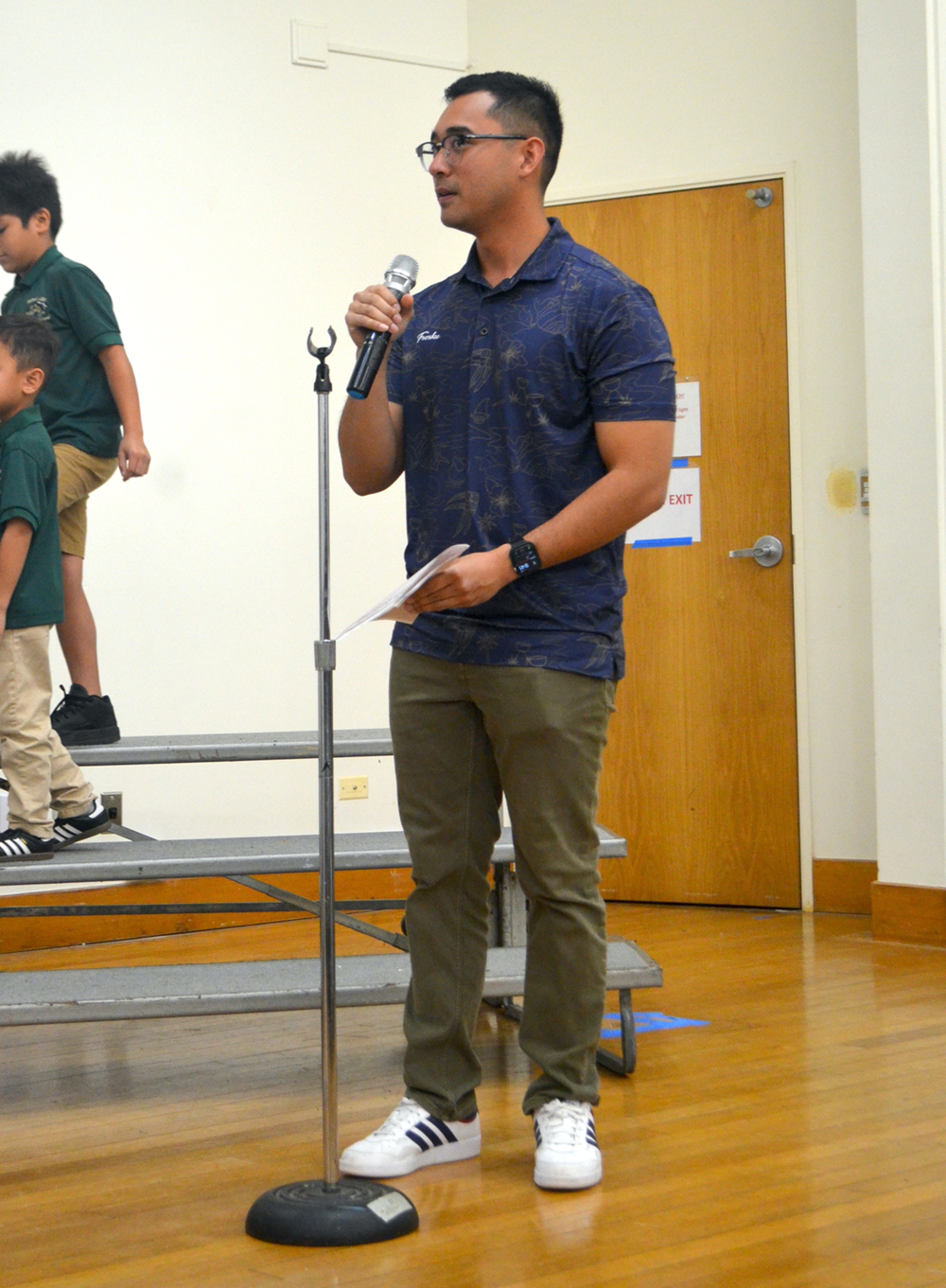
For Lizama, the goal for CHamoru is a future in which the language is used in daily life in Guam, from the schools to the mom and pop stores. Even more meaningful would be hearing it spoken from parents to children. “If we start hearing children play in CHamoru, fight in CHamoru, tease each other in CHamoru, that’s when we know we are doing good,” Lizama affirms.
With time, patience, and consistency from all learners committed to keeping CHamoru alive, Lizama is sure that the future he envisions is not only possible, but well within reach.